

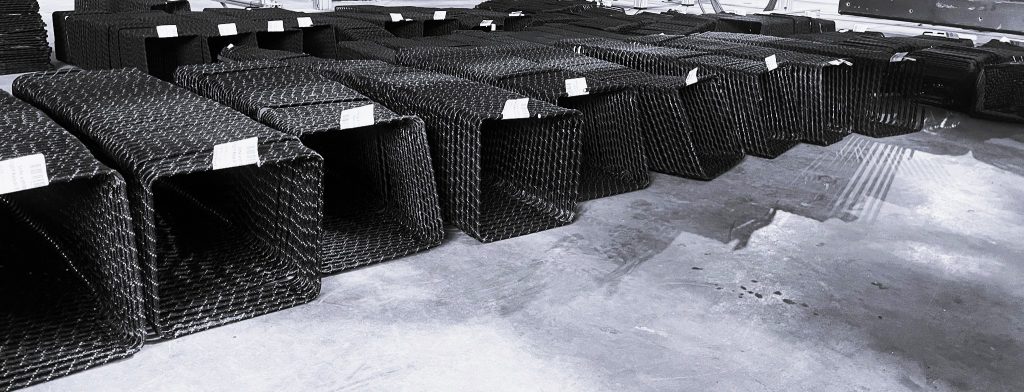
Stirrups play a crucial role in the safety of concrete structures, ensuring resistance to shear forces and controlling inclined cracks resulting from the combination of bending and shear.
These elements confine the concrete in critical zones—such as beam supports, cantilevers, and column-beam joints— ensuring a safer and more predictable behavior against the formation of diagonal failure mechanisms. The correct definition, distribution, and spacing of stirrups, according to Eurocode 2, is essential to ensure ductility, load-bearing capacity, and long-term structural performance.
The adoption of GFRP stirrups (composite bars) emerges as a competitive alternative solution, particularly in contexts where durability is a priority. Key benefits include corrosion immunity, reduced weight that facilitates transport and on-site assembly, and high specific strength, making this solution especially effective in aggressive environments.
It is important, however, to consider some material-specific characteristics, such as the lower modulus of elasticity compared to steel, which can influence deformability in certain situations, as well as the brittle failure behavior and the strict need to comply with the minimum bending radii defined by the manufacturer. Still, when properly specified, GFRP offers an excellent performance-to-durability ratio, significantly reducing maintenance costs over the infrastructure’s lifecycle.
Additionally, GFRP stirrups can be supplied in a helical configuration or as prefabricated pieces, allowing greater geometric regularity and faster assembly. These industrialized solutions ensure better dimensional quality, improved concrete adhesion, and higher construction efficiency, making them particularly attractive for projects that demand speed, repeatability, and strict control over construction processes.
Engº Pedro Faria
(Civil Engineer)